Top Ad 728x90

Saturday, October 17, 2026

The little-known tool that has revolutionized precise glass cutting since the 19th century

by


 Cutting glass with precision may seem like a job reserved for professionals. Yet, since the 19th century, a small tool has profoundly changed the way artisans work with this material: the glass cutter .

Simple in appearance, this tool creates a controlled line of weakness in the surface of the glass to facilitate its separation. But contrary to popular belief, the glass cutter does not actually “saw” the glass.

Its principle is based on a much more subtle operation: controlled scratching .

The principle of the glass cutter
A traditional glass cutter usually has a small wheel or an extremely hard point.


When the craftsman applies steady pressure and moves the tool forward on the glass, it creates a fine scratch called a cut line .

This mark does not go through the entire thickness of the plate. Rather, it initiates a controlled crack.

The glass can then be separated by applying appropriate pressure on either side of this line.

Why is accuracy so important?
A successful glass cut depends heavily on the quality of the scratch.


The craftsman must, in particular, check:

The pressure exerted on the tool
The trajectory
The speed of movement
The condition of the roulette wheel or the tip
The type and thickness of the glass
The way in which the glass is then separated
Insufficient pressure can produce an inadequate mark. Conversely, excessive pressure can create unwanted chips or cracks.

That’s why experience plays an important role, even with a good quality tool.

An invention that dates back to the 19th century
The first modern tools for cutting glass were developed in the 19th century, as the manufacture and use of glass became widespread in architecture, windows, mirrors and various craft trades.


Early models notably used hard materials capable of scratching glass.

The designs then evolved, notably with the use of small steel or carbide wheels , better suited to a regular cut.

Today, professionals also have specialized glass cutters for different types of work.

Why can a small roulette wheel cut glass?
Glass is a hard material, but it also has an essential characteristic: it is fragile and brittle .


When a sufficiently sharp scratch is created on its surface, it can serve as the starting point for a crack.

The separation does not occur because the tool removes a large amount of material. It occurs because the scratch guides the propagation of the fracture.

It is this principle that makes it possible to obtain a relatively straight cut with a surprisingly small tool.

The glass cutter is not suitable for all types of glass
This is an important point.


Not all glass can be cut in the same way.

Tempered glass , for example, is specially treated to improve its mechanical strength. Once tempered, it generally cannot be cut like a simple sheet of glass: any attempt to cut it can cause it to shatter.

Laminated glass, certain special glasses and complex glazing may also require adapted methods and equipment.

Before attempting to cut anything, it is therefore essential to know the type of glass involved.


How do professionals achieve a clean cut?
A precise cut begins with a clean and correctly positioned surface.

The craftsman first measures the piece, marks the desired trajectory and places the glass on a stable and suitable surface.

The stripe should then be made in a single, smooth movement whenever possible . Going over the exact same line several times can compromise the quality of the cut.

After the scratch, the separation must be carried out carefully.


For major work or expensive glazing, this operation is generally best left to a professional.

A simple tool, but not without danger
The glass cutter is small, but its use is not insignificant.

Broken glass can produce extremely sharp edges and small fragments that are difficult to see.

For the appropriate work, it is important to use suitable protection, including safety glasses and gloves designed for handling glass.


It is also necessary to work in an open space and prevent children and pets from approaching the work area.

Why is this tool still used today?
Despite the advent of modern cutting machines, the principle of the glass cutter remains remarkably useful.

For some simple cuts, the tool is:

Compact
Inexpensive
Easy to carry
Quick to use
Capable of producing precise cuts with good technique
Modern workshops, however, often combine hand tools, measuring systems and specialized machines depending on the type of glass and the required precision.


The real secret is not strength
One of the most misleading ideas about glass cutting is that it requires an enormous amount of force.

In reality, consistency and control are generally more important than power .

The purpose of the glass cutter is to create a line of weakness regular enough for the crack to follow its intended path.

It is this combination of the controlled fragility of the glass and the precision of the gesture that makes the tool so effective.


The final word
The glass cutter is an excellent example of a tool whose simplicity hides an ingenious technical principle.

Since the 19th century, its evolution has paralleled that of glassmaking and industry. Even today, the same fundamental concept remains: to create a precise score line to control fracture rather than attempting to cut glass like an ordinary material .

And it is precisely this idea, simple but ingenious, that explains why a small hand tool continues to have its place in glassmaking.

Safety tips
Cutting glass can cause serious cuts and flying shards. Do not attempt to cut tempered glass or any type of glazing you do not know. For large sheets, special glazing, or work requiring high precision, hire a professional equipped for this type of work.

See Why👀👀👀 👇👇💬

by


 Imagine you’re walking down the street and notice a wallet lying on the ground. You pick it up and open it to find identification, credit cards, and $1,000 in cash.

For a moment, you might feel tempted to keep the money. After all, nobody saw you pick it up.

But then you realize that someone probably lost it—and they may be desperately looking for it.

So what should you do?


Step 1: Don’t Take the Money

The first thing to do is leave the contents of the wallet together.

Don’t remove the cash, credit cards, identification, or anything else.

Even if you’re tempted to think, “I’ll just take some of it and return the wallet,” that can create additional problems and make it much harder to demonstrate that you tried to return everything.


Step 2: Look for Identification

Check whether the wallet contains something that can help identify its owner.

You might find:

  • A driver’s license
  • National identification card
  • Work ID
  • Business card
  • Membership card
  • Contact information

If you can identify the person, contacting them directly may be the quickest way to return the wallet.

Step 3: Don’t Publicly Reveal Everything Inside

If you post about finding a wallet online, avoid publishing all of its identifying details.

For example, instead of writing:


“I found John’s brown wallet containing $1,000, three bank cards, and an ID.”

you could simply say:

“I found a wallet near [general location]. If you believe it’s yours, contact me and describe it.”

This allows the genuine owner to identify it.


Step 4: Contact the Owner Carefully

If you find a phone number or other legitimate contact information, reach out politely.

You could say:

“Hello, I found a wallet that appears to belong to you. I’d like to return it. Please tell me where you believe you lost it and describe the wallet so I can confirm it’s yours.”Don’t ask them to send sensitive information such as passwords, PINs, or banking credentials.

Step 5: Consider Returning It Through an Appropriate Authority

If you don’t feel comfortable meeting a stranger, you can consider taking the wallet to the local police, relevant lost-and-found service, business where it was found, or another appropriate authority.

This can be particularly useful if the wallet was found in a store, airport, hotel, public transportation system, or other managed location.


Step 6: If You Meet the Owner, Keep the Situation Simple

Arrange to meet in a safe public place if you’re returning it personally.

You can ask the person to describe the wallet or some of its contents before handing it over.

Once you’re satisfied that you’ve found the rightful owner, return everything you found.


You don’t need to make the situation complicated.

Step 7: Don’t Assume the Cash Is Yours

Finding something doesn’t automatically mean you have the right to keep it.

Laws concerning lost property vary by location, including rules about reporting found property and what happens if an owner cannot be located.


If you’re unsure about your legal obligations, contact the appropriate local authority rather than assuming you can simply keep the money.

What If Nobody Claims It?

This is where things become more complicated.

If you’ve made reasonable efforts to locate the owner and nobody comes forward, don’t automatically assume you can keep the wallet and cash.


Local laws may specify what you should do with unclaimed property, including whether it must be turned over to authorities or whether a finder can eventually claim it under certain circumstances.

The safest approach is to follow the rules where you found it.

What If You Really Need the Money?

This is probably the hardest part of the situation.


Maybe you’re struggling financially. Maybe $1,000 would make a huge difference in your life.That doesn’t change the fact that someone else may have lost money they desperately need.

The person who lost the wallet could have been saving for rent, groceries, medical expenses, a family emergency, or something else important.

You don’t know their circumstances.


What Would You Do?

That’s what makes this situation such an interesting question.

Would you:

A. Return the wallet immediately?


B. Try to find the owner yourself?

C. Give it to the police or another authority?

D. Keep the cash but return the wallet?

The last option might sound tempting to some people, but it crosses an important ethical and potentially legal line.


The Bigger Lesson

A wallet containing $1,000 can test someone’s character in a matter of seconds.

Nobody may be watching.

Nobody may know what you found.


But the person who lost it knows exactly what that money means to them.

Returning someone’s lost property doesn’t make you poorer. It means you chose to respect someone else’s belongings even when you had an opportunity not to.

And someday, the situation could be reversed.


What Strange Creature Is This? A Closer Look at the Ringed Caecilian

by

The image above shows a unique, legless creature resting in a glass dish. It has a smooth, segmented body with a pale, grayish-pink color and prominent rings around its body. The text asks a simple question: what strange creature is this? This is a common reaction when people encounter an animal they have never seen before.

What Is This Creature?

This creature is a caecilian. It is a type of amphibian, like a frog or salamander, but it has no legs. It is often mistaken for a snake or a large worm, but it is neither. Its appearance is unique. The rings around its body are called annuli. They help the creature move through soil and mud. The small, dark spot near its head is an eye, though it is very small.

Where Do Caecilians Live?


Caecilians are found in tropical regions around the world. They live mostly underground. They burrow through soil and leaf litter. They are rarely seen because they spend most of their time hidden. They prefer damp, dark environments. This is why they are often found in gardens, forests, and sometimes in greenhouses.

Are They Dangerous?

Caecilians are not dangerous to humans. They do not have venom. They do not bite. They are harmless creatures that feed on small insects and worms. If you find one, it is best to leave it alone or move it to a safe, damp area outdoors. They are an important part of the ecosystem because they help aerate the soil.

Why It Might Be in the House


If you find a caecilian in your house, it likely came in by accident. It may have been brought in with potted plants or soil. It may have entered through a small gap in search of moisture. It is not a sign of an infestation. It is simply a creature that has wandered into an unfamiliar space.

 The Bottom Line

The creature in the image is a caecilian. It is a legless amphibian that lives underground. It is harmless and beneficial. If you find one, there is no need to be afraid. Simply move it to a safe outdoor area where it can continue to live.

Have you ever seen a caecilian before? Share your experience in the comments below.

Can You Find the Man? The Hidden Figure Optical Illusion

by

The image above presents a classic visual puzzle. At first glance, it shows a woman looking out of a window. There are shutters on either side of her, and below the window, there are plants and flowers. The text at the top says that your brain is still young if you can find the man. But where is he? This is a well-known optical illusion that has been shared for generations.

The Hidden Figure

If you look closely at the foliage below the window, you will notice something unusual. The leaves and shadows form the shape of a man’s face. He is looking to the left, and his features are subtly blended into the drawing. Once you see him, it is hard to unsee. The man is hidden in plain sight, camouflaged within the natural lines of the plants.

Why These Puzzles Are Popular


Optical illusions like this have been popular for centuries. They are a fun way to test observation skills and challenge the brain. They also show us how our perception works. Our brains are wired to recognize faces and patterns. This is called pareidolia. It is the tendency to see faces in random objects, like clouds or tree bark. This puzzle uses that tendency to trick the viewer.

How to Improve Your Observation Skills

If you enjoy these types of puzzles, there are ways to get better at them. First, slow down. Most people scan images quickly. Instead, take your time and look at every part of the picture. Second, look at the image from different angles. Sometimes, turning the image or looking at it from a distance can help you see the hidden shape. Third, pay attention to patterns and textures. The hidden figure often blends in with the background.

Why This Matters for Your Brain

Engaging in visual puzzles is not just a fun distraction. It is also a form of mental exercise. It challenges your brain to process information in new ways. It can help improve concentration, attention to detail, and cognitive flexibility. Keeping your brain active with puzzles, reading, and learning new things is important for long-term brain health.

The Bottom Line

The man is hidden in the foliage below the window. If you found him, congratulations. Your observation skills are sharp. If you did not, do not worry. These puzzles are meant to be challenging. Keep practicing and you will get better. The important thing is to enjoy the process and keep your brain engaged.

Did you spot the man? Share this puzzle with your friends and see if they can find him too.


The Yard Find I Didn't Expect.

by


 I love a good garden mystery.

Not a serious one. I don’t need bones under the patio or a cursed box behind the shed. Give me a strange lump in the soil, though, and I’m hooked.

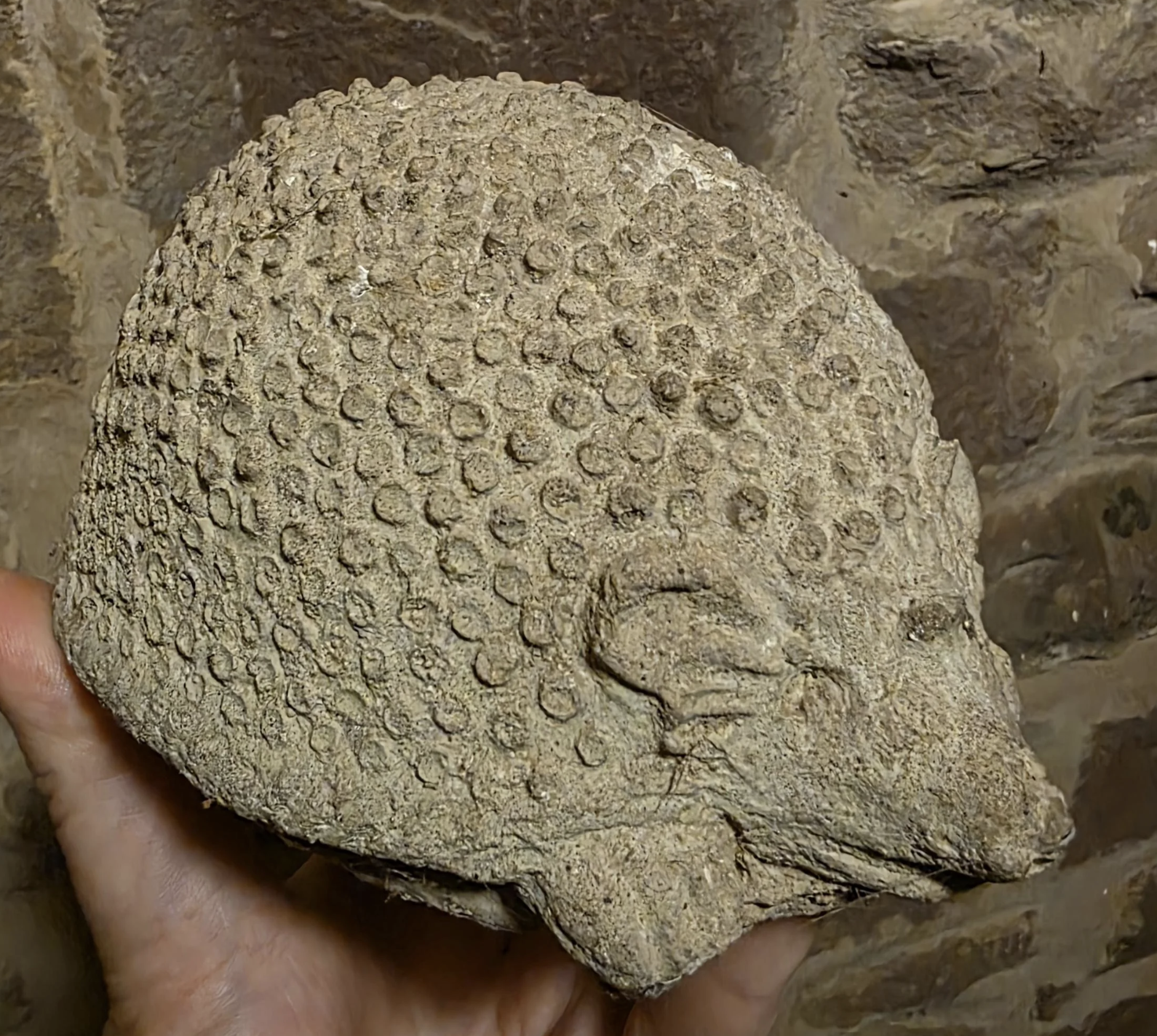
This buried garden ornament mystery started with two round, bumpy things sitting in the dirt. They looked partly natural and partly man-made, which is the worst kind of garden puzzle. Too odd to ignore. Too muddy to identify.

At first, I thought they might be fungi. Then, for one daft moment, coconuts crossed my mind. Gardens do that to you. You find one weird object and suddenly your brain starts auditioning every possible explanation.


Then the answer turned out to be better.

They were hedgehogs.

The Start of the Buried Garden Ornament Mystery

The first clue was the texture.


The objects had small raised bumps all over them. Soil covered most of the surface, but the pattern still showed through. Roots ran nearby, yet none seemed attached. That made them feel even stranger.

They didn’t look freshly placed. They looked settled. Forgotten. Like they had been quietly waiting underground for years.

The surface felt tough too. Almost made. But old fungi can fool you. Some puffball-like fungi dry out and become hard, crusty, and oddly artificial-looking.

So fungus wasn’t a ridiculous guess.


A strange guess, yes. But not ridiculous.

The Yard Find I Didn’t Expect

Then the Shape Clicked

Once lifted from the soil, the shape started to make sense.


Rounded back. Little pointed end. Bumpy surface. It looked less like a fungus and more like a small hedgehog curled up for a nap.

And once I saw that, I couldn’t unsee it.

It reminded me of those old garden hedgehog ornaments or door-stoppers. The heavy little kind people used to leave by patios, sheds, porches, or flowerbeds. Cute, solid, slightly grumpy-looking.

The sort of thing that seems decorative until it spends years underground and comes back looking like an ancient relic.


Mystery Solved

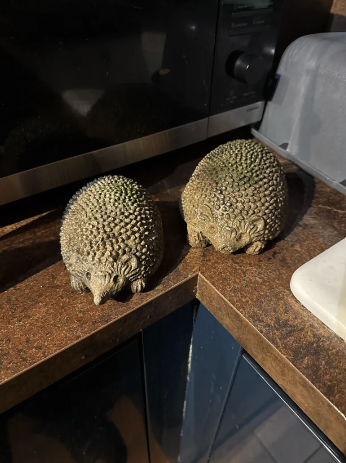
The final photo settled it.

Two hedgehog ornaments sat on the kitchen counter, both with the same bumpy backs, rounded bodies, and tiny faces.

Not fungus, not coconut and not fossil.


Just garden hedgehogs.

That made the whole thing funnier. Someone probably placed them outside years ago. Maybe they got moved, knocked over, buried by soil, or forgotten during a garden tidy-up. Rain, roots, and time did the rest.

Then one day, they reappeared as a full-blown buried garden ornament mystery.

Why Old Garden Ornaments Are So Charming


This is the part I love.

Old garden ornaments have personality. A hedgehog by the door. A frog near the pond. A rabbit tucked under a shrub. A gnome pretending to fish beside some marigolds.

None of it needed to match. That was the charm.

These little objects made gardens feel lived in. They turned a plain flowerbed into someone’s space. Someone chose that hedgehog. Someone liked it enough to give it a spot.


Then the garden swallowed it.

Years later, it came back looking mysterious and important. Honestly, good for the hedgehog. Great comeback.

The Yard Find I Didn’t Expect

A Small Mystery With a Perfect Ending


This story stuck with me because it was so ordinary and so funny.

No treasure. No rare discovery. Just a muddy hedgehog ornament causing confusion.

But that’s why it works.

Gardens keep memories in strange ways. They hide old labels, broken pots, toy cars, marbles, tools, and apparently hedgehogs pretending to be fungi.


This buried garden ornament mystery had the perfect ending because the answer was hiding in plain sight. We guessed, we overthought it and we laughed.

Sometimes the garden gives you flowers.

Sometimes it gives you a muddy hedgehog and a very good story.

Did you know BATS come to your house when… See more

by


 The appearance of a bat inside a home often causes a mix of surprise, concern, and curiosity. For many people, this unexpected encounter immediately raises questions: is it simply an accident, or does it carry some hidden meaning? Over time, various beliefs have attempted to give symbolic explanations to these situations, but science offers a much clearer answer based on the natural behavior of these animals.

From a biological perspective, the presence of a bat inside a house is not connected to mysterious intentions, but rather to specific environmental factors.

One of the most common reasons is nighttime disorientation.

Bats use a system called echolocation, which allows them to navigate in darkness by emitting sounds and interpreting their echoes. However, artificial lights, reflective surfaces, or open windows can interfere with their orientation, accidentally leading them into enclosed spaces.


Another frequent factor is the search for food.

Many bats feed mainly on insects, so the lighting inside a house may attract mosquitoes and other small organisms. While following this food source, the bat may unintentionally enter the home. In these cases,

its presence is simply the result of a natural survival behavior.

It is also possible that the bat is looking for temporary shelter.


Changes in weather, such as rain or strong winds, may cause it to seek a protected place to rest. Human homes, with their dark and quiet corners, can seem like suitable shelters under certain circumstances. In addition, small openings in roofs, vents, or cracks can serve as entry points, especially in urban areas where bats often live close to people.

Despite these scientific explanations, collective imagination has

created many symbolic interpretations surrounding bats. In some cultures, bats are associated with good luck, prosperity, or positive changes. In other traditions, they are linked to the unknown or surrounded by negative myths and misconceptions. However, it is important to clarify that there is no scientific evidence supporting the idea that a bat entering a house has a supernatural or spiritual meaning.As for safety, most situations do not represent a direct risk if handled carefully.


The main recommendation is to avoid direct contact, remain calm, and help the bat

find its way out by opening doors or windows. It is also advisable to keep children and pets away to prevent any incidents. Although, in rare cases, some bats may carry diseases, the risk is very low as long as they are not handled.

Beyond the negative perceptions often associated with them, bats play a fundamental role in maintaining ecological balance.

They are major allies in pest control, consuming enormous quantities of insects every night. In addition, they contribute to key processes such as pollination and seed dispersal, helping sustain


diverse ecosystems.

In this context, a bat visiting a home should be understood as a natural and, in most cases, accidental event. It is not a hidden sign or an enigmatic message, but simply the result of the interaction between the animal and its environment. Understanding this behavior allows people to replace fear with knowledge and appreciate the importance of these species in nature.

Ultimately, far from myths and popular beliefs, the presence of a bat in a house can be explained by simple and natural causes. Knowing this not

only helps people respond appropriately to these situations, but also encourages a greater appreciation for the role bats play in the world we share.

What I Found on My Balcony Froze Me in Terror—Until I Learned What It Really Was

by


 The Shadow That Breathed

It started as a “blank” morning—one of those 2026 routines where you move completely on autopilot. You reach for the balcony handle, the cool air hits your face, and you take that first, deep breath to wake up your soul. But that morning, my gaze “stumbled.”

Right there, embedded in the texture of the balcony wall, something was moving.

It wasn’t the wind. It wasn’t a trick of the light. It was slow, strange, and possessed a life of its own. In a split second, my “autopilot” brain went into full-blown survival mode. My insides clenched. My first thought was a shadow. My second—the one that made my blood run cold—was a snake. My palms turned slick with sweat, and my breathing became ragged. I froze, literally afraid to blink, convinced that any movement would trigger an attack from the creature living inside my architecture.


But as I stood there, paralyzed in the quiet of the morning, I realized the horror was much more complicated than a simple predator.

The Shadow That Breathed

It started as a “blank” morning—one of those 2026 routines where you move completely on autopilot. You reach for the balcony handle, the cool air hits your face, and you take that first, deep breath to wake up your soul. But that morning, my gaze “stumbled.”

Right there, embedded in the texture of the balcony wall, something was moving.

It wasn’t the wind. It wasn’t a trick of the light. It was slow, strange, and possessed a life of its own. In a split second, my “autopilot” brain went into full-blown survival mode. My insides clenched. My first thought was a shadow. My second—the one that made my blood run cold—was a snake. My palms turned slick with sweat, and my breathing became ragged. I froze, literally afraid to blink, convinced that any movement would trigger an attack from the creature living inside my architecture.


But as I stood there, paralyzed in the quiet of the morning, I realized the horror was much more complicated than a simple predator.3. The “Little-Known” Truth About Our Scaly Neighbors

In 2026, as we build more “concrete jungles,” the natural habitats of small reptiles like skinks are shrinking. They often end up in our walls not as pests, but as refugees.

Harmless Helpers: Despite their “snake-like” appearance, skinks are completely harmless to humans. They aren’t venomous, and they aren’t aggressive. In fact, they are the “gardeners” of the balcony, eating the spiders and insects we actually dislike.


The “Bite” Myth: A skink will only bite if it is seriously terrified or handled roughly. Their primary defense isn’t an attack; it’s a retreat.

The Pity Pivot: The moment I realized it was a skink, the fear vanished. It was replaced by a crushing sense of pity. I wasn’t looking at a threat; I was looking at a life that was about to go out right in front of me.

4. The Rescue: Why “Doing Something Right” Changes You
I spent the next twenty minutes with a small spatula and a pair of tweezers, gently widening the crack and nudging the little warrior toward freedom.

The Release: When it finally popped out, it didn’t run. It sat on the balcony tile for a long minute, its throat pulsing as it caught its breath. We sat there together—two creatures who had been terrified of each other just moments before.


The Aftermath: Strangely, after the adrenaline faded, a profound calm settled over me. I had started the morning thinking my home was “haunted” or “unsafe,” and I ended it realizing that my home was a sanctuary for more than just me.

What I Found on My Balcony Froze Me in Terror—Until I Learned What It Really Was

5. Nana’s Wisdom: “Fear is Just a Wall You Haven’t Looked Closely At”
Nana used to find all sorts of “critters” in her garden, and she never once reached for a broom to hit them. She’d reach for a magnifying glass or a bowl of water.

She used to tell us, “Most things people call ‘monsters’ are just small things that got lost in a big world.” She believed that fear was a choice we made when we didn’t have all the facts. She’d say, “If something is moving in the dark, don’t run for the light—bring the light to it.” Nana had a theory about the “Heartbeat of the House.” She’d say, “A house that has lizards in the walls and birds in the eaves is a house that’s alive. Be worried when the walls stop moving—that’s when the soul has left the building.” She knew that our fear of “the other” is usually just a lack of empathy. She’d say, “You’ll never be afraid of a snake once you realize it’s just a belly trying to find a warm rock.”


The Takeaway: Look Again
The next time you see something “strange” moving in the corner of your eye, or you hear a rustle in a place that should be silent—don’t let the “Real Horror” take over.

Most of the time, the “monster” in your wall is just a tiny soul that got stuck while trying to find its way home. In 2026, we have enough real things to be afraid of; let’s not add innocent neighbors to the list. Taking a second look didn’t just save a lizard’s life—it saved my morning.

Have you ever had a “jump-scare” moment with a tiny creature that turned out to be completely harmless? How did you handle the “Monster in the Wall”?