
The first thing I noticed was the color.;
Blue.
There was blue where no blue had ever belonged.
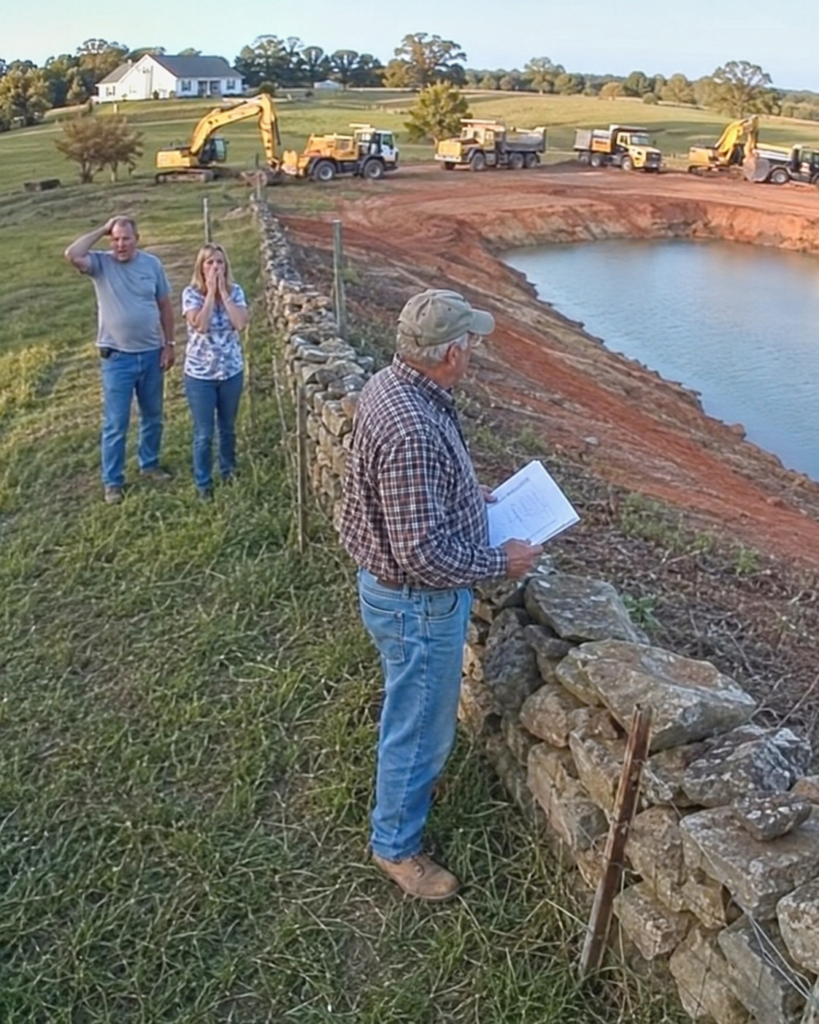
I had come over the ridge in my old Ford with the windows down and the late-summer heat pouring through the cab like breath from a furnace. The road back there was not really a road, just two hard-packed tire tracks running between waist-high grass, sweetgum saplings, and a line of pines my grandfather had planted before my father was old enough to hold an ax. I had driven that path thousands of times in my life. I could have done it blindfolded, though my grandfather would have slapped the back of my head for saying so. Every rut had a memory. Every bend had a reason. The land opened at the top of the ridge the same way it always had, rolling down into my southern pasture, dipping toward the spring, rising again toward the old stacked-stone fence that marked the boundary between Mercer land and the property south of it.Only now, in the middle of that pasture, the sunlight flashed off water.
For a few seconds, my mind refused to understand what my eyes were seeing. I stopped the truck with one boot still hovering over the brake and stared through the dusty windshield. It looked like a mirage at first, one of those heat tricks Alabama can play on a man in August when the air is thick and the horizon shimmers. But mirages don’t have cut banks. Mirages don’t have raw red clay piled in mounds. Mirages don’t have excavator tracks carved deep enough to hold yesterday’s rain.
I killed the engine and listened to it tick itself quiet.
The pasture below me had been opened up like somebody had taken a blade to it. A wide basin stretched across nearly two acres of land that had been mixed hardwood and grass when I left nine days earlier. Water had already gathered in the bottom, brown-blue and still, reflecting the sky like it had every right to be there. The banks had been shaped. Straw had been thrown over the edges. A pipe ran from the direction of my spring, diverting the water that had fed our creek for longer than I had been alive. The spring that my grandfather had cleaned by hand with a shovel and a wheelbarrow. The spring my father used to drink from when he was a boy. The spring my wife and I had once walked to on a hot July evening, back before there was no wife to walk with anymore.
I opened the door and stepped out.
The smell hit me then. Diesel, wet clay, cut roots, churned earth. A smell like violence dressed up as improvement.
I walked down the hill slowly because if I moved too fast, I was afraid the anger would get ahead of me. The ground had been chewed by heavy machinery. Young oaks lay snapped and half-buried in the dirt. A white oak sapling my niece had planted five years earlier was gone entirely, nothing left but a torn root ball rolled against a mound of clay. The grass was crushed flat where tracks had turned. The spring channel had been cut and redirected, its clean, cold water feeding the new basin instead of following the shallow line it had followed since before my family owned the place.When I reached the edge, I stood there and looked across the water.
It was not a pond. It was not a little decorative feature a person could call a misunderstanding. It was a lake. A full, deliberate, expensive lake dug with machines and confidence.
On my land.
Advertisements
My name is Daniel Mercer, and my family has owned 480 acres of timber and pasture in northern Alabama since 1962. My grandfather, Walter Mercer, bought it from a man named Eli Pritchard, whose people had held the land since the Depression. Back then, the place was half worn-out pasture and half pine scrub, with a creek running cold through the lower hollow and an old stone fence along the southern ridge. My grandfather saw more in it than everybody else did. He saw timber that could be managed, pasture that could be brought back, water that could sustain cattle through a dry summer, and enough space for his children and their children to know where they came from.
He was not a sentimental man in the way people use that word. He did not make speeches at dinner or talk about feelings unless somebody was dying. But he believed land was a covenant. Not property in the way a bank sees property. Not an asset line or an investment vehicle. Land, to him, was memory under your feet and responsibility over your head. He taught me to mend fence before he taught me to drive. He taught me how to read cloud shadows moving over a pasture, how to tell which pines needed thinning, how to recognize when a creek was running muddy because somebody upstream had done something stupid.
And he taught me about boundaries.
The old stacked-stone fence marked our southern line. It ran along the ridge in a crooked, stubborn way, following the land instead of fighting it. Nobody alive knew exactly who built it. The county records referenced “stone boundary markers” as far back as 1871. The fence was older than my grandfather, older than my father, older than every argument that would ever happen around it. Some stretches had fallen slightly over the years, but the line was unmistakable, hand-laid stones rising from the ridge like a spine.When I was twelve, my grandfather caught me sitting on that fence throwing pebbles at a stump on the other side.
“Don’t sit on a boundary, Danny,” he said.
I hopped down, thinking I had damaged something. “I didn’t knock any loose.”
“That ain’t what I mean.”
He walked over, rested one boot on the lower stones, and looked south toward the neighboring pasture. “A boundary is a promise. It tells your neighbor where your responsibility ends and his begins. You respect his side, he respects yours, and everybody sleeps better.”
Then he looked at me with those pale gray eyes that always seemed to know when I was only half listening.
“Land’s the only thing they’re not making more of,” he said. “You take care of it, it’ll take care of you. But if you let somebody move the line once, they’ll come back with a bigger shovel.”
I remembered that sentence while I stood beside the lake that did not belong there.
For most of my life, the land south of ours belonged to Mr. Rollins. His first name was Edward, but nobody called him that except his late wife, and even she mostly called him Rollins when she was irritated. He ran cattle, patched fences with baling wire, and drove a blue tractor that coughed black smoke every time he started it. He was quiet in the way old farmers can be quiet, not because they have nothing to say but because most things worth saying don’t require decoration.
We never had a boundary problem. If one of his cows slipped through a weak spot, he came and got it. If a storm knocked a cedar across the fence, we cut it together. Once, his bull got loose and tore up half an acre of my ryegrass, and he showed up the next morning with two fence posts, a roll of wire, and an apology so brief it would have fit on a matchbook. That was enough. People worked things out because they expected to see each other again at the feed store, at church, at the county co-op, or broken down on the shoulder of Highway 72 with a flat tire and no cell signal.When Mr. Rollins died, things changed slowly at first and then all at once.
His children did not want cattle. They did not want a weathered farmhouse or a barn leaning into its own shadow. They wanted money, which was their right. About a year after the funeral, the property sold to Brent and Laurel Whitaker from Nashville.
I met them in April.
I was clearing brush along the stone fence when a shiny side-by-side rolled up on their side of the line. Brent was driving. Laurel sat beside him wearing oversized sunglasses and a white sleeveless vest that looked too clean for anywhere near pasture. They were in their mid-forties, both polished, both smiling the way people smile when they believe charm is a universal key. Brent had tanned skin, expensive teeth, and the energy of a man who had never walked into a room doubting it would rearrange itself around him. Laurel was quieter, watchful, with blonde hair tucked under a cap and a phone in one hand, as if she was already framing the world for someone else to see later.
“Hey there,” Brent called. “You must be Daniel Mercer.”
“That’s right.”
He climbed out and stepped toward the fence but not over it. I noticed that. At the time, I appreciated it.
“Brent Whitaker,” he said. “This is my wife, Laurel. We bought the Rollins place.”
“Welcome to the neighborhood,” I said.
Laurel smiled. “It’s beautiful out here. So peaceful.”
“It can be.”
Brent looked around as if he were inspecting a resort property. “We’re thinking of making some improvements. Nothing too crazy. Just cleaning things up, maybe adding some water, trails, a little retreat feel.”
I rested my brush hook against my shoulder. “Plenty of room for it.”
He glanced at the stone fence. “This is the boundary?”Yes, sir. This fence has marked it longer than anybody here has been breathing.”
“Good to know,” he said, but he only looked at it for maybe three seconds.
My grandfather would have noticed that too.
Still, I had no reason to expect trouble then. People move from the city all the time and need a while to learn the rhythm of rural land. They call pastures “fields,” call creeks “streams,” think a tractor can be scheduled like a lawn service, and assume every tree can be removed if it blocks a view. Most learn. Some don’t. I figured the Whitakers would find their way or sell when the mosquitoes got bad.
Three months later, my younger brother Caleb called from Chattanooga.
Caleb has always been the one life grabs by the collar. Not because he is foolish, though he can be. Not because he is lazy, because he is not. He just has a talent for believing the next thing will solve everything. A new job, a new town, a new woman, a new truck he can barely afford. This time, the warehouse supervisor job he had moved for had fallen through after a company restructuring that sounded to me like three executives made mistakes and the men loading pallets paid for it. His lease was ending, his savings were thin, and pride kept him from asking for help until the last possible minute.
“I hate to ask,” he said on the phone.
“You already asked by saying that.”
He laughed, but it was tired. “I need to move back.”
“I’ll bring the truck.”
I spent nine days in Chattanooga helping him pack a life that had not worked out. We loaded boxes into my trailer, hauled furniture down narrow apartment stairs, argued over whether a sagging recliner was worth keeping, and ate takeout on the floor because his dishes were already wrapped in newspaper. At night, he slept on a mattress and I slept on a borrowed couch with one spring trying to tunnel through my ribs. He kept apologizing. I kept telling him to shut up and lift.Caleb was raw with disappointment. I knew that feeling. I had worn my own version of it after my wife, Rebecca, left seven years earlier. She did not leave with drama. That might have been easier. She left gently, with tears and exhaustion, saying she could not spend the rest of her life competing with ghosts, land, and grief. My father had died the year before, my mother two years before that, and I had buried myself in work because fences, timber plans, cattle leases, and tractor repairs did not ask me to explain myself. Rebecca wanted a husband. I became a caretaker for acreage and memory.
By the time I understood the difference, she was gone.
So when Caleb said his life felt like a field after a storm, flattened and muddy, I knew not to offer a speech. I told him what my grandfather would have told him: “We’ll get it standing again.”
When I finally drove home, I was tired enough that my hands ached from gripping the wheel. But I did not go to the house first. Maybe that sounds strange to people who do not own land that has passed through generations. But after being gone, I needed to put eyes on it. Needed to see the pine rows, the ridge, the creek, the pasture, the fence. Needed to remind myself that at least one thing in the world stayed where it was supposed to stay.
Then I came over the ridge and saw the lake.
I called Brent from the edge of it.
He answered on the second ring, cheerful. “Daniel. What’s going on?”
I looked at the water rising over land my grandfather had walked. “Is there a lake on my property?”
A pause.
Not surprise. Not confusion.
A pause.
“Oh,” he said. “You saw that.”The words lowered something cold into me.
“Yes, Brent. I saw it. It’s north of the stone fence. A good forty yards north.”
He sighed, as if I had interrupted dinner to complain about music. “Our contractor verified the boundary before breaking ground. We hired a professional survey crew. They assured us we were within our parcel.”
“They assured you wrong.”
“Fences aren’t always accurate, Daniel.”
“This one is.”
“With respect, old fences can be misleading.”
“With respect, so can people who want something.”
His voice tightened. “We spent close to thirty-five thousand dollars on excavation already. We did our due diligence.”
I looked across the torn earth, the redirected spring, the crushed saplings. “Your due diligence just dug a hole in my land.”
“I think we should let the professionals sort this out.”
“I think you should stop work immediately.”
There was another pause, shorter this time.
“I’ll talk to the contractor,” he said.
But he did not say yes.
That was the first clear warning.
Over the next few days, I tried to let reason lead anger around by the collar. I took photographs. I walked the fence. I marked distances. I pulled my deed, my father’s deed, and copies of old boundary notes from a file cabinet in my office. I did not call Brent again because I knew the next conversation would not be neighborly. Instead, I called Harold Bennett.
Harold was a surveyor who had done timber assessment work for me years earlier. He was in his late sixties, thin as a fence rail, with sun-browned skin, a white mustache, and the patience of a man who trusted measurements more than moods. He had a habit of removing his glasses before saying something unpleasant, as if he wanted the world slightly blurred when people reacted badly.He came out two mornings later in a faded khaki shirt, carrying old plats, a GPS unit, survey flags, and a metal detector that looked older than both of us. Caleb came too, mostly because he was still sleeping in my spare room and needed something to do besides feel like a failure.
Harold walked the fence first.
He did not rush. He read the land the way some men read scripture, slowly and with the assumption that every detail mattered. He found an old iron pin half-buried near the western corner, exactly where the 1904 survey referenced it. He found stone piles at two turning points. He compared the fence line to the old plat. He took bearings. He made notes in a small book. Caleb and I followed him like students waiting for grades.
Finally, Harold stopped near the highest point of the ridge, removed his glasses, and looked toward the lake.
“Daniel,” he said, “that excavation is entirely on your property.”
Caleb let out a low whistle.
I felt relief first. Then anger, stronger because it had permission now.
“You’re sure?”
Harold looked offended. “Yes.”
“Could there be any gray area?”
“No.”
“How far over?”
“At the nearest point, about thirty-seven feet. At the main basin, more like forty yards. They didn’t nick your line. They crossed it with confidence.”
He showed me the overlay. The old stone fence aligned with the documented boundary. The spring channel was mine. The basin was mine. The damaged trees were mine. There was no interpretation that made Brent and Laurel’s lake belong to them.
Harold drafted a formal notice that afternoon. We sent it certified mail. Stop work immediately. Restore the land to its prior condition. Remove unauthorized structures or improvements. Eighteen days.
I believed, foolishly, that facts would settle it.Facts do settle many things among people who respect them. But facts are less effective against pride with a lawyer attached.
A week later, a letter arrived from a Nashville law firm. Cream paper. Heavy envelope. Language polished smooth enough to hide the insult. Brent and Laurel had relied on a licensed survey. They had acted in good faith. Their contractor had verified the site. Any claim of encroachment was disputed. Any attempt to interfere with their project would be treated as harassment and pursued accordingly.
I read it once standing by the mailbox.
Then I read it again at my kitchen table with Caleb across from me drinking coffee.
He watched my face. “Well?”
“They’re not stopping.”
He took the letter and skimmed it. “Can they do that?”
“They already did.”
“No, I mean can they win?”
I looked out the kitchen window toward the back acreage I could not see from there but could feel like a pressure behind my ribs. “This isn’t about winning yet. This is about whether they think I’ll get tired.”
Caleb set the letter down. “Will you?”
I almost smiled. “You know better.”
I drove to the Whitakers’ place that afternoon. Their new gravel drive was white and clean, with fresh landscaping along the entrance and a gate they had not yet wired to close. The house they were building sat high on their side of the property, all glass, dark siding, and sharp angles, like something from a magazine called Modern Rural Living written by people who never had to pull a calf at midnight. I found Brent by the lake—my lake, though I hated even thinking the phrase—talking to two contractors installing fountain aerators.
The dock frame was new.
That stopped me for a moment.
It extended over the water from the south bank, neat and expensive, with treated lumber stacked nearby. Stakes marked a future seating area. Laurel stood farther back with a tablet in her hands, showing something to a landscaper. She looked up when she saw me and did not smile.Brent waved. “Daniel. You get the letter?”
“I did.”
“Then you understand where we stand.”
I walked past him to the edge of the water. The lake had risen another foot. The spring pipe fed it steadily, clear water disappearing into muddy arrogance. Straw had been spread over the banks. Someone had already planted clumps of ornamental grass.
“You’re still working,” I said.
“Our attorney advised us to complete scheduled improvements unless there is a court order.”
“Your attorney advised you to keep digging on land that isn’t yours?”
“Our survey says otherwise.”
“Your survey ignored the physical monuments.”
He crossed his arms. “Daniel, I understand this land means a lot to you. I do. But we’re not trying to steal anything. We’re trying to build something beautiful. This could benefit both properties.”
“You never asked me.”
“We didn’t think we needed to.”
“That’s the problem.”
His jaw tightened. “Look, maybe when this is resolved, if a small adjustment needs to be made, we can discuss compensation.”
“There it is.”
“What?”
“You’re betting I’ll sell you the problem you created.”
Laurel walked over then, her face controlled. “That’s unfair. We’ve invested a lot in this project.”
“On my land.”
“Based on professional advice.”
“Then your professionals can help you fill it back in.”
She looked at me as if I had said something obscene. “You would really destroy a lake?”
“I would restore my pasture.”
Brent shook his head. “You’re being emotional.”
I laughed once, not because it was funny. “No, Brent. Emotional was calling you before I called the county. Emotional was giving you a chance to fix it quietly. What comes next is documentation.”
I left before I said more.
There is a calm that comes when a line has been crossed so cleanly that doubt burns away. I had wanted this to be a mistake. I had wanted Brent to come over with his hat in his hands and say the contractor messed up, they would fix it, sorry for the trouble. I would have been angry, but I would have worked with him. We could have restored the spring, reshaped the land, maybe even found a way to salvage peace.But he had chosen strategy over neighborliness.
He believed speed, money, and a finished project would change the moral weight of the thing. If they made it beautiful enough, expensive enough, emotionally valuable enough to them, maybe I would hesitate. Maybe I would accept a check. Maybe I would be made to feel unreasonable for defending what had been mine before they ever saw it on a real estate listing.
He did not understand the kind of man my grandfather had raised.
Harold filed a boundary affidavit with the county. He helped me submit a land disturbance complaint and a request for injunctive relief. We hired a local attorney named Ruth Ann Pell, a woman in her early sixties with steel-gray hair, practical shoes, and the conversational warmth of a locked gate. She had grown up on a farm two counties west and had been making arrogant men regret underestimating her since 1987.
At our first meeting, she read everything in silence. Brent’s attorney letter. Harold’s report. The old plats. The photographs. The certified notice. Then she looked at me.
“You want money or restoration?”
“Restoration.”
She nodded once, as if that was the answer she had hoped for. “Good. Money gets messy. Boundaries are cleaner.”
Caleb came with me to that meeting. On the ride home, he said, “She scares me.”
“Good. We’re paying her to scare other people.”
The preliminary hearing was scheduled in county court. The courtroom was small, paneled in dark wood, smelling faintly of floor polish, old paper, and coffee that had been burned for too many hours. The judge was Honorable Elaine Porter, a woman in her early sixties with sharp eyes and the tired patience of someone who had heard every possible version of “I thought it was mine.”
Brent wore a tailored suit. Laurel wore cream linen and sat perfectly upright. Their attorney did most of the talking, using words like good faith reliance, modern survey methods, improvement value, and ambiguity. Ruth Ann let him talk. Harold testified with the dry precision of a man more interested in being accurate than impressive. He explained the historic boundary, the stone fence, the survey markers, the county records, the errors in the Whitakers’ GPS-based survey, and the contractor’s failure to reconcile the old physical monuments with the newer approximation.The judge listened without much expression.
Then she asked Brent’s attorney three questions.
“Did your clients have notice of the historic fence line before excavation?”
He hesitated. “They were aware of a fence, Your Honor, but disputed its legal significance.”
“Did the survey they relied upon reference the 1871 boundary record?”
“I would have to review—”
“That means no?”
A pause. “Not explicitly.”
“Did they continue construction after receiving certified notice from Mr. Mercer?”
He glanced back at Brent. “Some previously scheduled work continued.”
Judge Porter leaned back. “That means yes.”
Fifteen minutes later, she ruled. The stone fence constituted a recognized historic boundary consistent with recorded deeds and physical monuments. The excavation lay entirely within my property. Brent and Laurel were ordered to cease all work and restore the land to prior condition within twenty-one days. If they failed, I was authorized to undertake restoration at their expense.
It sounded almost anticlimactic when she said it.
A lake that had made my chest burn for weeks became a few paragraphs in a court order.
Outside the courthouse, Brent approached me near the steps.
“This doesn’t have to get uglier,” he said.
“It already got ugly when you dug across the fence.”
“You’re really going to make us destroy it?”
“I’m not making you do anything. The court gave you a choice.”
He looked genuinely angry then, but beneath it I saw something else. Confusion. He still did not understand why I would not negotiate. In his world, everything had a price if you found the right number. In mine, some numbers were insults because they assumed the wrong thing was for sale.
Twenty-one days came and went.
Nothing changed.
Worse than nothing. They doubled down.
Landscapers planted more ornamental grasses. The dock was finished. A stone fire pit appeared near the bank. I drove by one evening and saw Laurel sitting on the dock with her feet above the water, a wine glass in her hand, watching the sunset reflect off a lake that existed because she and her husband had decided my boundary was inconvenient.I will tell the truth: for one brief second, it looked peaceful.
The sky was gold. The water was still. The dock was handsome. If you did not know what had been cut, redirected, buried, and ignored to create it, you might have thought it belonged there.
That second was dangerous.
That is how encroachment works sometimes. Not with ugliness, but with beauty used as an argument. Once a wrong thing becomes attractive, people start asking whether undoing it is wasteful. They stop asking who had the right to do it in the first place.
I heard my grandfather again.
You let one thing slide, you teach people how to treat you.
On day twenty-two, I called Curtis Hale.
Curtis owned Hale Earthworks and had been moving dirt across three counties for more than thirty years. He was a compact man with a gray beard, heavy hands, and a voice that rarely rose above a gravelly murmur. He had buried water lines, built farm ponds, repaired washed-out roads, cleared storm damage, and once moved an entire hillside back where it belonged after a developer learned drainage the hard way.
He came out, looked at the lake, read the court order, and spat into the dirt.
“You sure?” he asked.
“Yes.”
“This won’t be pretty.”
“It wasn’t pretty when they dug it.”
He nodded. “We’ll do it clean.”
We met at sunrise two days later. Curtis brought two bulldozers, an excavator, three dump trucks, and men who worked quietly because good operators do not need to narrate power. Harold came too with his clipboard and camera. Ruth Ann told me to document everything, so we did. Photographs before. Photographs during. Copies of the order in three trucks and one in my back pocket.
Caleb stood beside me at the ridge, arms crossed. “You okay?”“No.”
“You want to be talked out of it?”
“No.”
“Good. Because I wasn’t planning to.”
The air was cool for August, though it would not stay that way. Mist lifted from the unauthorized water. Birds moved along the bank, confused by the human drama gathering around their temporary habitat. Curtis walked up beside me.
“Last chance,” he said.
I looked at the lake and tried to imagine leaving it. Tried to imagine telling myself it was easier to settle, easier to sell that strip, easier to live with the thing and call it compromise. Then I imagined walking my future grandchildren to the stone fence and explaining why the boundary moved because one man had enough money to dig first and argue later.
“Do it,” I said.
The first bulldozer blade cut into the bank with a wet, tearing
sound.
The lake fought harder than I expected. Water always looks calm until you ask it to leave. Mud slumped. Clay collapsed. The basin released itself in surges, not gracefully but angrily, rushing into the channels Curtis had cut to control the flow and return water toward the spring’s natural course. The dock tilted within the first hour, one side dropping as the supporting bank gave way. Men moved with chainsaws and straps, dismantling it section by section. Fountain pipes came out. Electrical lines were capped and removed. Ornamental grasses were pulled. Straw matting rolled back in filthy sheets.
By midmorning, Brent arrived in a cloud of gravel dust.
He jumped out before his truck stopped fully. “You can’t just do this!”
Harold held up the order.
“We gave you twenty-one days,” I said.
Laurel arrived minutes later, pale and furious, one hand pressed to her mouth as if she had discovered vandalism instead of enforcement. She stared at the dock sections stacked on a trailer.Not enough to regret anything. But enough to see him as smaller than the problem he created. He was not a villain in a black hat. He was a man accustomed to the world bending around money and momentum, and he had mistaken that habit for reality. Laurel, too, had built a dream on a false line and then loved the dream more than the truth.
Outside the courthouse, Brent stopped me one last time.
“You could have worked with us,” he said.
There was no heat in it now. Just fatigue.
“You never tried to work with me,” I said. “You tried to outspend me.”
He looked like he wanted to argue, then realized he had no clean place to stand.
The Whitakers listed the property the following spring.
Rural counties have their own newspapers, even when nothing is printed. Feed stores, barbershops, church parking lots, county offices, diners, hardware stores—word moves through all of them faster than any formal notice. By the time their retreat property hit the market, everybody knew about the lake that came and went. Prospective buyers asked about drainage, legal disputes, neighbors, boundary lines, and whether the stone fence was “the famous fence,” which made me laugh the first time Ruth Ann told me.
The property sat for months.
When it finally sold, it went for less than they paid.
I do not know how much they lost, and I never tried to find out. I did not want them ruined. Ruin was not the point. Respect was. A boundary is not meaningful because it destroys people who cross it. It is meaningful because it still stands after they try.
The new owners came by the week after closing. Retired couple from Birmingham. Tom and Elaine Bowers. He had worked for the power company. She had taught high school English for thirty-two years and had the posture of a woman who could silence a room with one raised eyebrow. They brought a pecan pie and introduced themselves on my porch like people used to do more often.Tom shook my hand. “We’ve heard about the fence.”
I smiled. “It’s a good fence.”
“We don’t plan on testing it.”
Elaine looked past my shoulder toward the back acreage. “We’d like to walk it with you sometime, if you don’t mind. Make sure we understand everything clearly.”
That sentence did more for peace than any legal letter ever could have.
The following Saturday, we walked the boundary together. Caleb came too, mostly for the pie afterward. I showed them the old stone line, the iron pin, the spring, the restored pasture, still rough but already greening. Tom listened. Elaine asked good questions. No one assumed. No one performed expertise. No one said “our contractor told us” as if that ended conversation.
At the spring, Elaine stood quietly for a moment.
“This must have hurt to see changed,” she said.
It was such a simple, decent thing to say that I had to look away.
“Yes, ma’am,” I said. “It did.”
Grass came back thick where the lake had been. Not all at once. Land heals slowly and unevenly, like people. The first year, weeds came strongest, pigweed and ragweed and stubborn volunteer grasses. Curtis told me to be patient. Harold suggested a seed mix that would stabilize the soil and support the spring channel. Caleb helped me spread it one cool morning in October, both of us walking back and forth with broadcast spreaders strapped to our chests like two men sowing the aftermath of a war neither of us would have chosen.
By the second spring, clover appeared. Then fescue. Then young hardwood shoots along the edge where the machinery had crushed saplings. The spring cleared. The creek ran cold again. Deer returned to crossing the lower pasture at dusk. One evening I saw a fox trotting along the restored bank with something small in its mouth, the land already forgetting the shape of the wrong done to it.I did not forget as quickly.
For nearly two years, I replayed arguments in my head while fixing fence, driving tractor, or lying awake before dawn. I thought of better things I could have said. Sharper things. Kinder things. I wondered whether I should have hired Ruth Ann sooner, pushed harder earlier, insisted on a joint survey the first week, called the county the first day. Anger is not loud forever. Eventually, it becomes a room in the mind where you keep walking around rearranging furniture that no longer matters.
What finally settled me was not the court order or the money or the Whitakers leaving.
It was a conversation with Caleb.
He had moved into a rental in town by then and found steady work with a logistics company. He came out one Saturday to help replace a gate near the southern ridge. We worked most of the morning, sweating through our shirts, arguing about hinge placement, and eating gas station sandwiches on the tailgate at noon. After a while, he looked toward the restored pasture.
“You ever wish you’d sold them the strip?”
“No.”
“Not even once?”
I took a drink of warm Gatorade. “Once or twice, I wished I was the kind of person who could.”
He nodded like he understood.
“Would’ve been easier,” he said.
“Maybe.”
“But then every time you looked that way, you’d know.”
That was exactly it.
People talk about standing your ground as if it is always proud and clean. It is not. Sometimes it is expensive, lonely, and ugly. Sometimes it makes you look unreasonable to people who only see the surface. Sometimes you destroy something that looks beautiful because the way it got there was wrong. Sometimes the cost of peace is too high because it requires you to lie to yourself every time you walk past the place where the line used to be.


0 comments:
Post a Comment